




Aerobic or Anaerobic? Why It Matters Which Energy System You're Training
Exercise isn’t one single thing you do “hard” or “easy.” Underneath every session, you’re stimulating specific energy systems, and aerobic and anaerobic training are genuinely different systems with different demands and benefits.
Two Different Systems, Not Two Speeds
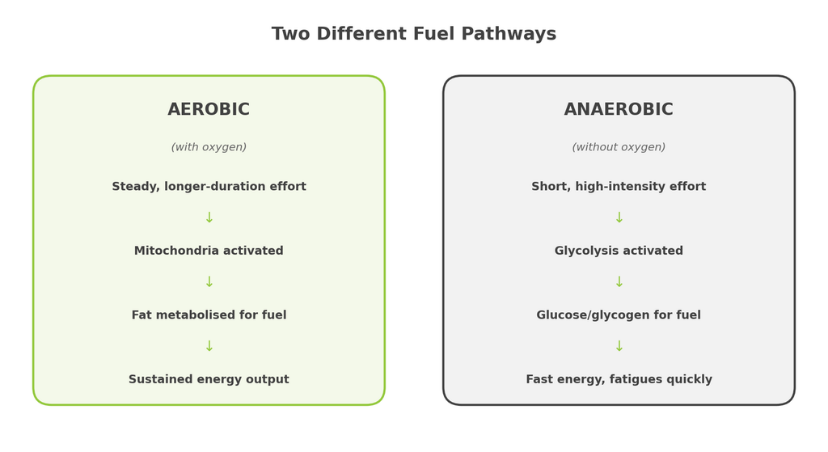
It’s tempting to think of aerobic and anaerobic training as points on the same dial, with anaerobic being “harder” aerobic. That’s not quite right. Aerobic training — steady, conversational-pace work — relies on oxygen to produce energy over longer durations, building your endurance base.
Anaerobic training — short, intense efforts like sprints or heavy lifting — draws on energy systems that don’t depend on oxygen in the moment, producing power quickly but only for short bursts.
It’s Not About Going Hard, It’s About Going On Purpose
Treating every session as “just go out there and get smashed” misses the point of what you’re actually training for. The more useful question before any session isn’t how hard you should go, but which energy system that session needs to target and why.

Are you building your aerobic base? Developing anaerobic power? Actively recovering? Conflating these is a big part of how people end up overtrained or burnt out without understanding why.
Bringing It Together
Knowing which energy system you’re working, and training it deliberately rather than just “going hard,” is what turns consistent effort into real, sustainable progress. This applies whether you’re managing everyday fitness or working through a broader recovery or nervous system health plan.

Not Sure Where Your Training Is Balanced?
If you’re not sure how your current training is balanced between aerobic and anaerobic work, or whether it’s set up to get you where you actually want to go, that’s exactly the kind of thing worth discussing with our team.
Spinewise in Maidstone can help assess your training approach alongside your broader health goals — call us on (03) 9318 7758 or book online.
Frequently Asked Questions

As a rough guide, if you can hold a conversation, you’re likely working aerobically. If you’re breathing too hard to talk and can only sustain the effort briefly, you’re in anaerobic territory.
Most people benefit from developing both, since they support different goals — endurance and recovery capacity on one hand, power and strength on the other.
It can be, but it generally needs more caution around technique, load, and recovery than aerobic work. Building some aerobic base first is often a sensible starting point.
Aerobic work tends to favour fat as a fuel source over longer durations; anaerobic work is more associated with building strength and power.

About the Author
Dr Trevor Chetcuti, B.Chiro.Sc, B.App.Sc (Clin), DIBAK, CNET
Dr Trevor Chetcuti is Clinical Director at Spinewise in Maidstone, holding dual degrees in Chiropractic and Clinical Science from RMIT University and a Teaching Diplomate in Applied Kinesiology through the International College of Applied Kinesiology (ICAK). He is chairman of ICAK International’s Board of Research and Standards and has spent over 20 years helping patients work through complex health, neurological and pain-related concerns.