
chiropractor near me

Serving Melbourne

for over 20 years

pain specialist melbourne

35 Churchill Ave , Maidstone

VIC 3012, Australia

icon-sticky

Serving Melbourne
for over 30 years

pain specialist melbourne

35 Churchill Ave , Maidstone, VIC 3012, Australia

Why an Overloaded Nervous System Can Look Like an Attention Problem

 Dr Trevor Chetcuti, B.Chiro.Sc, B.App.Sc (Clin), DIBAK, CNET | Clinical Director, Spinewise Maidstone

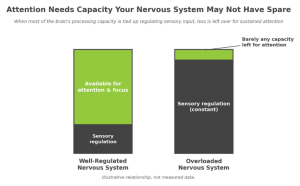
Throughout this series we’ve talked about how much work the brain does automatically just to regulate everyday sensory input. For some people, that background workload is so high that there isn’t much processing capacity left over for anything else, including paying attention.

Attention Takes Capacity, Not Just Willpower

Sustained attention, and especially trying to focus on two things at once, draws on the same limited processing capacity we’ve discussed elsewhere in this series. If most of that capacity is already being used to manage sensory overload, there’s genuinely less available for the mental effort of staying focused. This isn’t about trying harder. There’s only so much capacity to go around.

Why Distraction and Dual-Tasking Become Difficult

This is often what’s behind someone who can’t stick to one thing and gets distracted easily, or who finds that needing to focus on two things at once quickly becomes overwhelming. It’s not a lack of discipline. When the nervous system is already stretched thin regulating everything else coming in, there simply isn’t much spare capacity left to hold attention on a single task, let alone split it across two.

When This Starts Looking Like an Attention Issue

Over time, this pattern can start to look a lot like a classic attention difficulty: distractibility, trouble sustaining focus, real difficulty multitasking. For a lot of people, this ends up being labelled as an attention problem on its own, when the bigger driver is actually how much the nervous system is already managing in the background.

Why the Order of Operations Matters

As we’ve covered elsewhere in this series, it’s usually worth understanding how much of the brain’s capacity is already tied up regulating other input before treating attention as an isolated problem. Addressing that underlying load can sometimes free up capacity for attention that wasn’t available before, rather than only targeting the attention symptoms directly.

Where This Fits at Spinewise

At our Maidstone clinic, this is part of why our NeuroTracker attention program starts with a proper assessment rather than jumping straight to training. We look at the broader nervous system picture, including sensory regulation load, alongside standard attention-specific testing, then build a training plan around what’s actually driving the difficulty for that person.

Notice attention becoming harder to hold onto, especially when juggling more than one thing? Book an assessment with our team at https://pracsuite.bookings.pracsuite.com/guest and we’ll look at what’s actually going on.

Frequently Asked Questions

Not at all. The difficulty concentrating is genuinely real. This is about understanding one of the reasons behind it, rather than dismissing it.

Not exactly. ADHD is a specific diagnosis with its own criteria. What we’re describing here is a related but distinct pattern, where attention difficulty stems from an already overloaded nervous system. A proper assessment is the only way to understand what’s driving it for you.

For some people, yes. If a lot of capacity is tied up managing sensory overload, reducing that load can free up capacity that then becomes available for attention and focus.

We combine standard attention-specific testing with a broader look at nervous system regulation, then use that to guide a tailored NeuroTracker training plan.

Dr Trevor Chetcuti

About the Author
Dr Trevor Chetcuti, B.Chiro.Sc, B.App.Sc (Clin), DIBAK, CNET

Dr Trevor Chetcuti is Clinical Director at Spinewise in Maidstone, holding dual degrees in Chiropractic and Clinical Science from RMIT University and a Teaching Diplomate in Applied Kinesiology through the International College of Applied Kinesiology (ICAK). He is chairman of ICAK International’s Board of Research and Standards and has spent over 20 years helping patients work through complex health, neurological and pain-related concerns.