
chiropractor near me

Serving Melbourne

for over 20 years

pain specialist melbourne

35 Churchill Ave , Maidstone

VIC 3012, Australia

icon-sticky

Serving Melbourne
for over 30 years

pain specialist melbourne

35 Churchill Ave , Maidstone, VIC 3012, Australia

Why the Same Overload Can Show Up as Migraines in One Person and Anxiety in Another

Dr Trevor Chetcuti, B.Chiro.Sc, B.App.Sc (Clin), DIBAK, CNET | Clinical Director, Spinewise Maidstone

Two people can be carrying a very similar amount of unprocessed sensory and cognitive input, and end up with completely different symptoms. One gets anxious. The other gets migraines. Neither of them is imagining it, and neither pattern is more “real” than the other. It often comes down to where their nervous system is more resilient, and where it isn’t.

Resilience Isn’t Uniform Across the Brain

Throughout this series we’ve talked about the nervous system’s overall capacity to regulate input. That capacity isn’t spread evenly across every area of the brain. Someone can be genuinely resilient in the areas that handle fear and anxiety responses, while a different area, one more closely tied to head pain pathways, is far less able to absorb the same load.

When One Area Is More Vulnerable, That’s Where It Shows Up

When input isn’t being coped with, it has to go somewhere. If the more vulnerable area happens to be tied into anxiety circuits, that’s where the strain surfaces. If it’s an area more specifically connected to migraine pathways, unresolved input can end up expressed as a migraine instead. Same underlying overload, different output, depending on which part of the system is carrying the weaker link.

Lifestyle Habits Can Shift Where the Overload Comes Out

This is where things get more interesting. Something as simple as a regular exercise habit can genuinely buffer the anxiety side of things, so someone feels calm and their anxiety stays manageable. But if their brain is still just as wound up overall, that load hasn’t disappeared. It can still come out as migraines, because exercise buffered one pathway without necessarily protecting the other. Lifestyle factors don’t always reduce total overload. Sometimes they just change which pathway ends up carrying it.

Why This Matters for How We Think About Symptoms
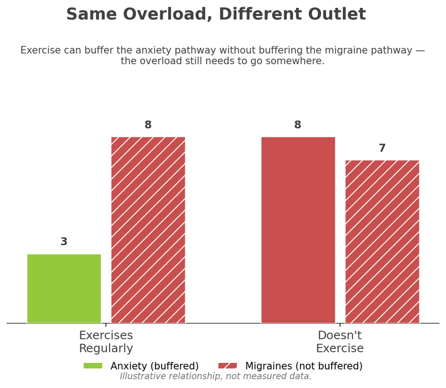
Why Acting on It Sooner Can HelpIt’s tempting to treat migraines and anxiety as two unrelated problems, especially when someone says their anxiety is fine but they still get migraines. Understood this way, they can be two different expressions of a similar underlying overload, shaped by which parts of someone’s nervous system are more resilient and which lifestyle factors are already buffering one side of the picture.

Where This Fits at Spinewise

At our Maidstone clinic, this is part of why we look at the whole picture, lifestyle habits, presenting symptoms and where someone’s resilience and vulnerability actually sit, rather than treating a migraine or an anxious pattern as an isolated issue to solve on its own.

Notice your anxiety is manageable but you still get migraines, or the other way around? Book an assessment with our team at https://pracsuite.bookings.pracsuite.com/guest and we’ll look at what’s actually driving your particular pattern.

Frequently Asked Questions

Not necessarily. It means exercise can buffer one pathway, often the anxiety side, without automatically protecting another, like a migraine pathway. The relationship is different for everyone, which is why an individual assessment matters.

It often comes down to where someone’s nervous system is more resilient and where it’s more vulnerable. Unresolved input tends to surface through whichever pathway is least able to absorb it.

Yes, that’s a common pattern. It doesn’t mean either one is less real. Both can be different expressions of a similar underlying load on the nervous system.

We look at lifestyle habits, presenting symptoms and the broader nervous system picture together, rather than treating migraines or anxiety as separate, unrelated issues.

Dr Trevor Chetcuti

About the Author
Dr Trevor Chetcuti, B.Chiro.Sc, B.App.Sc (Clin), DIBAK, CNET

Dr Trevor Chetcuti is Clinical Director at Spinewise in Maidstone, holding dual degrees in Chiropractic and Clinical Science from RMIT University and a Teaching Diplomate in Applied Kinesiology through the International College of Applied Kinesiology (ICAK). He is chairman of ICAK International’s Board of Research and Standards and has spent over 20 years helping patients work through complex health, neurological and pain-related concerns.