
Why You Instinctively Shut Out Light, Sound and Talking During a Migraine
Anyone who’s had a bad migraine knows the instinct. You don’t want to hear anything, see anything, talk, or even think. It’s such a consistent pattern that it’s almost a defining feature of migraine itself. It isn’t just discomfort. It’s the nervous system doing something quite deliberate.
Your Cranial Nerves Carry an Enormous Amount of Input
As we’ve covered elsewhere in this series with the trigeminal nerve and jaw, several of the cranial nerves are constantly funnelling sensory information into the brain and brainstem. Vision, hearing, facial and jaw sensation, and internal signals all travel through this same general network. Under normal circumstances, the nervous system handles all of it without any conscious effort.

During a Migraine, That Same Input Becomes Unbearable
When the nervous system is already in an overloaded, hypersensitive state, as it is during a migraine, the ordinary amount of light, sound and mental effort that’s usually manageable suddenly becomes too much. There’s very little spare regulation capacity left, so anything extra pushes the system further into distress rather than being absorbed the way it normally would.

Withdrawing From Input Is a Protective Response, Not Just Avoidance
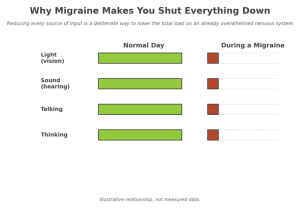
Not wanting to talk, think or engage with anything isn’t only about comfort. Talking, thinking, listening and looking around are all forms of sensory and cognitive input that need processing. By minimising light, sound, conversation and mental effort, someone is instinctively reducing the total load on an already overwhelmed system, giving it the best possible chance to settle.
Why This Makes Sense Given Everything We’ve Covered
This instinctive shutdown is the nervous system doing exactly what we’ve described throughout this series, reducing input when regulation capacity is exhausted. It’s the same underlying principle behind stepping away from screens or spending time in nature, just playing out in a much more acute and urgent way during an actual migraine.
Where This Fits at Spinewise
At our Maidstone clinic, this ties directly back to how we approach migraine and headache presentations, including the jaw and trigeminal nerve work we’ve covered elsewhere in this series. Understanding how much total input someone’s nervous system is managing, and what’s contributing to it, is part of a proper assessment rather than only addressing the migraine once it’s already underway.
Find yourself needing to shut everything out the moment a migraine starts? Book an assessment with our team at https://pracsuite.bookings.pracsuite.com/guest and we’ll look at what’s actually driving your migraines.
Frequently Asked Questions
The nervous system’s regulation capacity is already stretched thin during a migraine, so input that’s normally manageable, like ordinary light or background noise, adds directly to an already overwhelmed system.
For most people, continuing to take in light, sound and conversation during a migraine adds to the load rather than helping. Withdrawing from input is generally the nervous system doing something protective, not something to override.
Not exactly the same, but the instinct to reduce sensory and cognitive input during a migraine is extremely common. How much input matters, and which kind, can vary from person to person.
We look at the broader nervous system picture, including jaw and trigeminal input, alongside how much total sensory load someone is managing day to day, as part of understanding what’s driving their migraines.
About the Author
Dr Trevor Chetcuti, B.Chiro.Sc, B.App.Sc (Clin), DIBAK, CNET
Dr Trevor Chetcuti is Clinical Director at Spinewise in Maidstone, holding dual degrees in Chiropractic and Clinical Science from RMIT University and a Teaching Diplomate in Applied Kinesiology through the International College of Applied Kinesiology (ICAK). He is chairman of ICAK International’s Board of Research and Standards and has spent over 20 years helping patients work through complex health, neurological and pain-related concerns.


