chiropractor near me

Serving Melbourne

for over 20 years

pain specialist melbourne

35 Churchill Ave , Maidstone

VIC 3012, Australia

icon-sticky

Serving Melbourne
for over 30 years

pain specialist melbourne

35 Churchill Ave , Maidstone, VIC 3012, Australia

Why Deliberately Limiting Stimulation Can Help During a Migraine

Dr Trevor Chetcuti, B.Chiro.Sc, B.App.Sc (Clin), DIBAK, CNET | Clinical Director, Spinewise Maidstone

I’ll sometimes be in a room talking with a patient and, partway through, they’ll ask if we can turn the lights off, or slow down a little, or mention it’s a bit noisy in here. It usually comes up when someone’s dealing with a migraine or a similarly overloaded nervous system. It’s a small request, but it points to something worth taking seriously rather than just politely accommodating.

It’s Not Just a Comfort Preference

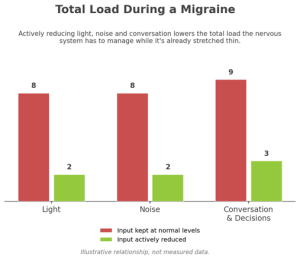
It’s easy to treat a request like this as someone simply being sensitive to their surroundings on a bad day. In practice, it’s the nervous system directly asking for less to manage. During a migraine, regulation capacity is already stretched about as far as it goes, and every extra bit of light, sound or conversation is more for an already overloaded system to process. Reducing that input isn’t indulgent. It’s addressing exactly what’s being asked for.

What Happens When Stimulation Isn’t Reduced

If the lights stay on, the conversation keeps going at a normal pace, and the background noise doesn’t change, that input doesn’t just get ignored. It keeps adding to a system that has very little spare capacity left. For a lot of people, continuing to take in a normal amount of light, sound and conversation during a migraine can make things feel worse rather than better, simply because there’s nowhere for that extra load to go.

Simple Ways to Actively Reduce Input

This doesn’t need to be complicated. Dimming or turning off lights, moving to a quieter space, slowing the pace of conversation, and cutting down on decisions or unnecessary talking are all straightforward ways to reduce the total load during a migraine. None of these are dramatic changes. They’re the same things people often ask for instinctively, just done deliberately and earlier rather than waiting until it’s unbearable.

Why Acting on It Sooner Can Help

Why Acting on It Sooner Can HelpWaiting until stimulation feels completely intolerable before reducing it means the nervous system has already been managing an excess load for longer than necessary. Bringing input down earlier, at the first signs of a migraine, gives the system less to work through overall, and for some people that’s enough to help things settle a little sooner.

Where This Fits at Spinewise

At our Maidstone clinic, we talk to patients about actively managing input during a migraine as part of a broader approach, alongside the jaw, trigeminal and nervous system assessment we’ve covered elsewhere in this series. Understanding what’s driving the migraine in the first place is important, but knowing how to reduce the load in the moment matters too.

Find yourself needing to shut out light and noise every time a migraine starts? Book an assessment with our team at https://pracsuite.bookings.pracsuite.com/guest and we’ll look at what’s actually driving your migraines, as well as how to manage them in the moment.

Frequently Asked Questions

Both. It can genuinely reduce the total input the nervous system has to manage while it’s already overloaded, alongside simply feeling more comfortable.

Generally, the earlier the better. Reducing input at the first signs, rather than waiting until it feels unbearable, gives the nervous system less to manage overall.

No. This is one practical piece alongside understanding what’s driving the migraine in the first place, which is best explored with a proper assessment.

We look at what’s contributing to migraines through a broader nervous system assessment, and talk to patients about practical ways to reduce input in the moment as part of the overall picture.

Dr Trevor Chetcuti

About the Author
Dr Trevor Chetcuti, B.Chiro.Sc, B.App.Sc (Clin), DIBAK, CNET

Dr Trevor Chetcuti is Clinical Director at Spinewise in Maidstone, holding dual degrees in Chiropractic and Clinical Science from RMIT University and a Teaching Diplomate in Applied Kinesiology through the International College of Applied Kinesiology (ICAK). He is chairman of ICAK International’s Board of Research and Standards and has spent over 20 years helping patients work through complex health, neurological and pain-related concerns.