

Why Consistency Beats Intensity for Long-Term Training Results
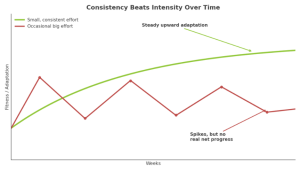
If you had to pick one lever that matters more for long-term results — how hard you train, or how consistently you train — consistency wins, and it isn’t close.

Your Body Handles a One-Off Just Fine
The body is remarkably good at absorbing an occasional big stress and bouncing back from it. A single hard session or an unusually intense effort is something we’re built to handle. The trouble isn’t the occasional spike; it’s what happens when that stress becomes constant rather than occasional.
Chronic Stimulation Is How Problems Build
Conditions like chronic fatigue rarely develop from one bad day. They build up from consistent, ongoing stimulation of the stress response, day after day, without enough recovery in between. It’s the consistency of the stress, not any single instance of it, that does the damage — and it’s exactly the same mechanism that makes training work, just pointed in a more useful direction.
Exercise Is Meant to Be Adaptive Stress, Not Injury
The entire point of exercise is to expose your physiological systems to a level of stress they can adapt to. When you consistently expose your body to a training stimulus, even a fairly small one, it learns to handle that stimulus more efficiently over time. Consistency is what keeps training on the right side of the line between adaptation and overload.

Building a Consistent Approach That Lasts
If your current approach relies more on occasional big efforts than steady regularity, that’s worth rethinking. Our team at Spinewise in Maidstone can help you build a training and recovery approach that’s genuinely sustainable — call us on (03) 9318 7758 or book online.
Frequently Asked Questions
No — it means high-intensity work needs to be dosed consistently and recovered from properly, rather than relied on as an occasional maximal effort.
Smaller than most people assume. Regular, modest stimulus applied consistently tends to produce more reliable adaptation than sporadic, larger efforts.
Yes, in principle — chronic fatigue tends to build from ongoing, unmanaged stress stimulation, while training uses the same mechanism deliberately, paired with recovery.
Consistency is generally the more useful thing to track and protect. It’s a better predictor of long-term progress than how hard any individual session was.
About the Author
Dr Trevor Chetcuti, B.Chiro.Sc, B.App.Sc (Clin), DIBAK, CNET
Dr Trevor Chetcuti is Clinical Director at Spinewise in Maidstone, holding dual degrees in Chiropractic and Clinical Science from RMIT University and a Teaching Diplomate in Applied Kinesiology through the International College of Applied Kinesiology (ICAK). He is chairman of ICAK International’s Board of Research and Standards and has spent over 20 years helping patients work through complex health, neurological and pain-related concerns.


