chiropractor near me

Serving Melbourne

for over 20 years

pain specialist melbourne

35 Churchill Ave , Maidstone

VIC 3012, Australia

icon-sticky

Serving Melbourne
for over 30 years

pain specialist melbourne

35 Churchill Ave , Maidstone, VIC 3012, Australia

Why Your Training Cycle Doesn't Have to Match the Calendar Week

There’s a very Hollywood image of what “good training” looks like — push, and push, and push again. It’s a compelling image, but it’s not how effective training actually works.

The Trap of the Seven-Day Week

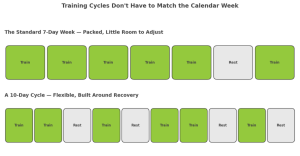
Most of us structure our training around the week without ever questioning it. The problem is when the week becomes the unit you’re measuring success against, rather than what your body actually needs. The seven-day frame isn’t a physiological reality; it’s just a convenient calendar box, and your recovery and adaptation needs don’t necessarily line up with it.

Training in Cycles That Actually Fit You

Instead of defaulting to “how many sessions this week,” it’s worth asking what cycle length actually suits what you’re doing. For some people, that might be a tighter three-day cycle. For others, it might stretch to ten days. High-intensity sessions might only need to happen two or three times within a cycle, with the rest built around recovery, even if that doesn’t map neatly onto “three times a week, every week.”

Slow Down to Speed Up

This connects to an idea popularised by endurance coach Phil Maffetone, often summarised as “slow down to speed up.” Training a little more conservatively, with more attention to recovery and pacing, frequently produces better long-term adaptation than simply doing more, more often, more intensely. Doing less, done well, can outperform doing more, done poorly.

Building a Cycle That Suits You

If your current routine is built entirely around the calendar week rather than around how you’re actually recovering, that’s worth reassessing. Our team at Spinewise in Maidstone can help you think through a training and recovery structure that actually fits your body — call us on (03) 9318 7758 or book online.

Frequently Asked Questions

It depends on the intensity of your sessions and how quickly you recover — lighter sessions might sustain a shorter cycle, while heavier work often needs a longer one.

Not necessarily. Beyond a certain point, adding more sessions without adequate recovery can reduce the quality of adaptation rather than improve it.

It varies by person and goal, but for many people two to three genuinely hard sessions within a cycle is enough.

It’s a concept popularised by endurance coach Phil Maffetone, describing how a more conservative, better-paced approach can produce greater long-term adaptation.

Dr Trevor Chetcuti

About the Author
Dr Trevor Chetcuti, B.Chiro.Sc, B.App.Sc (Clin), DIBAK, CNET

Dr Trevor Chetcuti is Clinical Director at Spinewise in Maidstone, holding dual degrees in Chiropractic and Clinical Science from RMIT University and a Teaching Diplomate in Applied Kinesiology through the International College of Applied Kinesiology (ICAK). He is chairman of ICAK International’s Board of Research and Standards and has spent over 20 years helping patients work through complex health, neurological and pain-related concerns.