





Improving Daily Cognitive Performance — Why You're Not Lazy, You're Just Overloaded
by Trev | Spinewise
You know the days I’m talking about.
The ones where you sit down to work, the to-do list is right in front of you… and nothing happens. You open a tab, close it. Start a task, stop. Check your phone. Stare at the screen. Somehow an hour passes and you’ve done almost nothing.
And then comes the familiar guilt. Why can’t I just focus? What’s wrong with me?
Here’s what I want you to hear: nothing is wrong with you.
What’s happening isn’t a motivation problem. It’s not a discipline problem. It’s not a character flaw. It’s a cognitive bandwidth problem — and once you understand that everything starts to make a lot more sense.
What Is Cognitive Bandwidth?
Think of your brain like a computer processor.
When it’s running well, it handles tasks smoothly — opens programs fast, switches between them easily, keeps everything moving. But open too many tabs, run too many background processes, and the whole thing slows to a crawl. Not because the computer is broken. Because it’s overloaded.
Cognitive bandwidth is basically your brain’s processing capacity. It determines how much mental work you can take on at any given moment — how quickly you can think, how many things you can hold in mind at once, how easily you can make decisions, and how long you can stay focused before you start to fade.
When it’s high, you feel sharp. Things flow. Decisions are easy.
When it’s low? That’s when you get:
Indecision — staring at two options and not being able to pick either
Mental fog — a kind of thick, slow feeling in your head
Task avoidance — starting something and immediately wanting to do anything else
Repeating yourself — re-reading the same paragraph, redoing the same calculation
Zoning out — you’re there but you’re not really there
Low follow-through — great intentions, nothing to show for them
Sound familiar? That’s cognitive overload. And it’s incredibly common.
Why This Happens
Cognitive bandwidth gets depleted by a lot more than just hard work.
Poor sleep is a big one. Chronic stress. Ongoing pain. Anxiety. A history of concussion or head injury. Even long periods of low-grade inflammation can quietly chip away at mental processing capacity.
And here’s the thing that most productivity advice misses completely: if your brain doesn’t have the capacity to perform, no amount of to-do lists, time-blocking, or “just push through it” is going to fix that.
You can’t motivate your way out of a bandwidth problem.
You have to actually address the underlying capacity.
Training the Brain Like a Muscle
This is where things get interesting.
Most people assume that cognitive function is just… fixed. That you either have a sharp brain or you don’t. That if you’re foggy and slow, that’s just where you’re at.
That’s not true.
The brain is trainable. The same way you can build physical fitness by challenging your cardiovascular system, you can build cognitive capacity by challenging your attentional and processing systems in the right ways.
The key word is challenge. Not just “use your brain” — actually push it beyond its comfort zone, consistently, in a structured way.
That’s the principle behind Neurotracker.
How Neurotracker Works
Neurotracker is a 3D cognitive training system built on over 20 years of neuroscience research. Here’s what a session looks like.
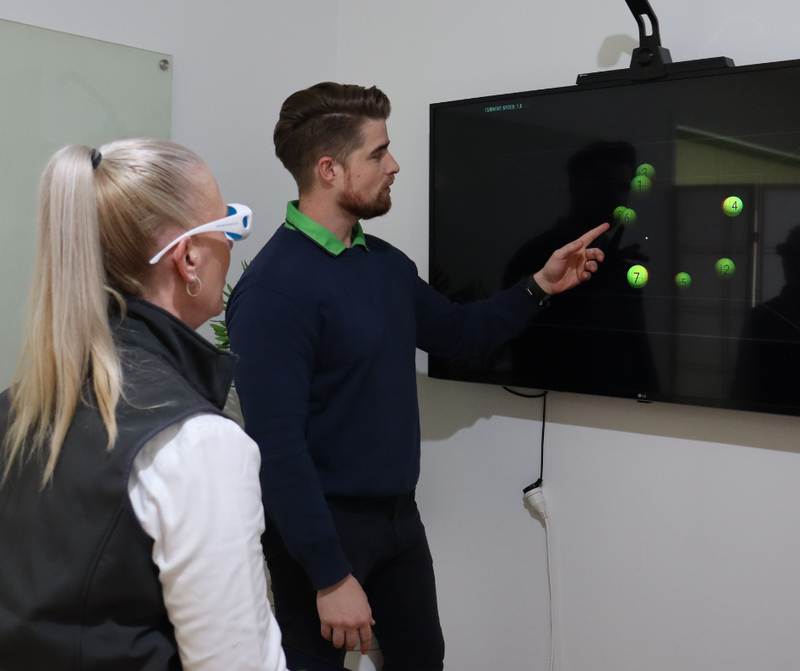
You watch a 3D display. A group of identical balls appears. A few are highlighted — those are your targets. Then they all start moving at once, bouncing around in 3D space. Your job is to keep tracking your targets through the chaos.
Six to eight minutes. That’s a full session.
It sounds simple. But that it is not.
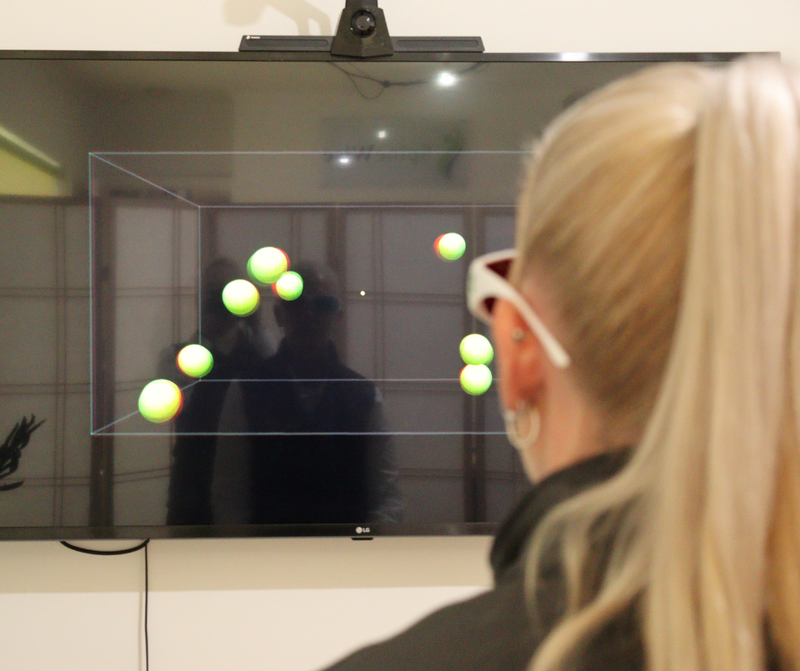
The system adapts constantly to keep you right at your limit — hard enough to force real effort, not so hard that you shut down. This is the sweet spot for neurological training.
What’s happening in those six minutes is that your brain is being forced to do several very demanding things simultaneously: sustain attention, track multiple moving targets, process depth and motion, and filter out everything that’s irrelevant. All at once. Under time pressure.
That’s a direct workout for the exact systems that drive focus, working memory, processing speed, and mental stamina.
What Improves with Training
The research on Neurotracker covers a wide range of populations — elite athletes, military personnel, concussion patients, older adults, students — and the outcomes that show up consistently include:
Working memory — your ability to hold information in mind while you use it. This is huge for follow-through. When working memory is weak, you lose the thread of what you were doing constantly.
Processing speed — how quickly your brain takes in and responds to information. When this is slow, thinking feels sluggish, decisions take forever, conversations are hard to keep up with.
Sustained focus — staying locked in on a task without drifting. This is what separates a productive hour from an hour of half-effort.
Task switching — moving cleanly between different things without losing your place or burning mental energy in the transition. Poor task switching is one of the biggest hidden drains on productivity.
Mental stamina — how long you can maintain cognitive performance before you start to fade. If you’re sharp for 45 minutes and then useless for the next two hours, stamina is the issue.
Improved decision making and execution – a big one for athletes. Making the right pass. Moving the right direction. Executing the right action.
When these systems improve, the knock-on effect on daily function is significant. Clearer thinking. Faster decisions. Better follow-through. Less avoidance. More mental energy at the end of the day.
What This Looks Like in Practice
I’ll be straight with you — this isn’t a magic fix. No single tool is.
Neurotracker works best as part of a broader picture. Sleep, movement, nutrition, managing stress — all of that still matters. But for people who’ve been doing the basics reasonably well and still feeling cognitively flat, or for people who’ve had a head injury or illness that knocked their processing offline, Neurotracker can be a genuine gamechanger.
In our office, we start with a brain performance assessment. That gives us a baseline — where your cognitive function actually sits right now, which systems are underperforming, and what kind of improvement is realistic for you. From there, training is personalised and progressive. Balance, TMJ function, energy metabolism and improving sleep are just some of the things we work through.
Most people are surprised at the flow on effect, and how quickly that starts to show up in daily life. Not in some vague “I feel a bit better” way — in concrete things. Finishing tasks. Making decisions without the usual back-and-forth. Not zoning out in conversations. Actually following through.
The Bottom Line
If you’ve been struggling to be productive and nothing you’ve tried has really worked, it’s worth asking whether the problem is capacity rather than mindset.
Your brain can be trained. Working memory, processing speed, sustained focus, mental stamina — these are all trainable. And when they improve, everything else gets easier.
That’s not a motivational slogan. That’s neuroscience.
If you want to find out where your cognitive performance actually sits and what’s possible from there, come in for a Brain Performance Assessment. Or just reply with “productivity” and I’ll point you in the right direction.
Cheers,
Trev
Spinewise is a multidisciplinary health clinic based in Maidstone, Melbourne, led by Dr. Trevor Chetcuti — chiropractor, Teaching Diplomate in Applied Kinesiology, and Chairman of ICAK International’s Board of Research and Standards. With over 25 years of clinical experience and post-graduate training in Chiropractic, nutrition, sports performance, functional neurology and Applied Kinesiology, Trev and the Spinewise teamwork with patients experiencing cognitive symptoms, post-concussion syndrome, brain fog, and complex health presentations. Book a Brain Performance Assessment at the link below or get in touch with our team directly by clicking here.