





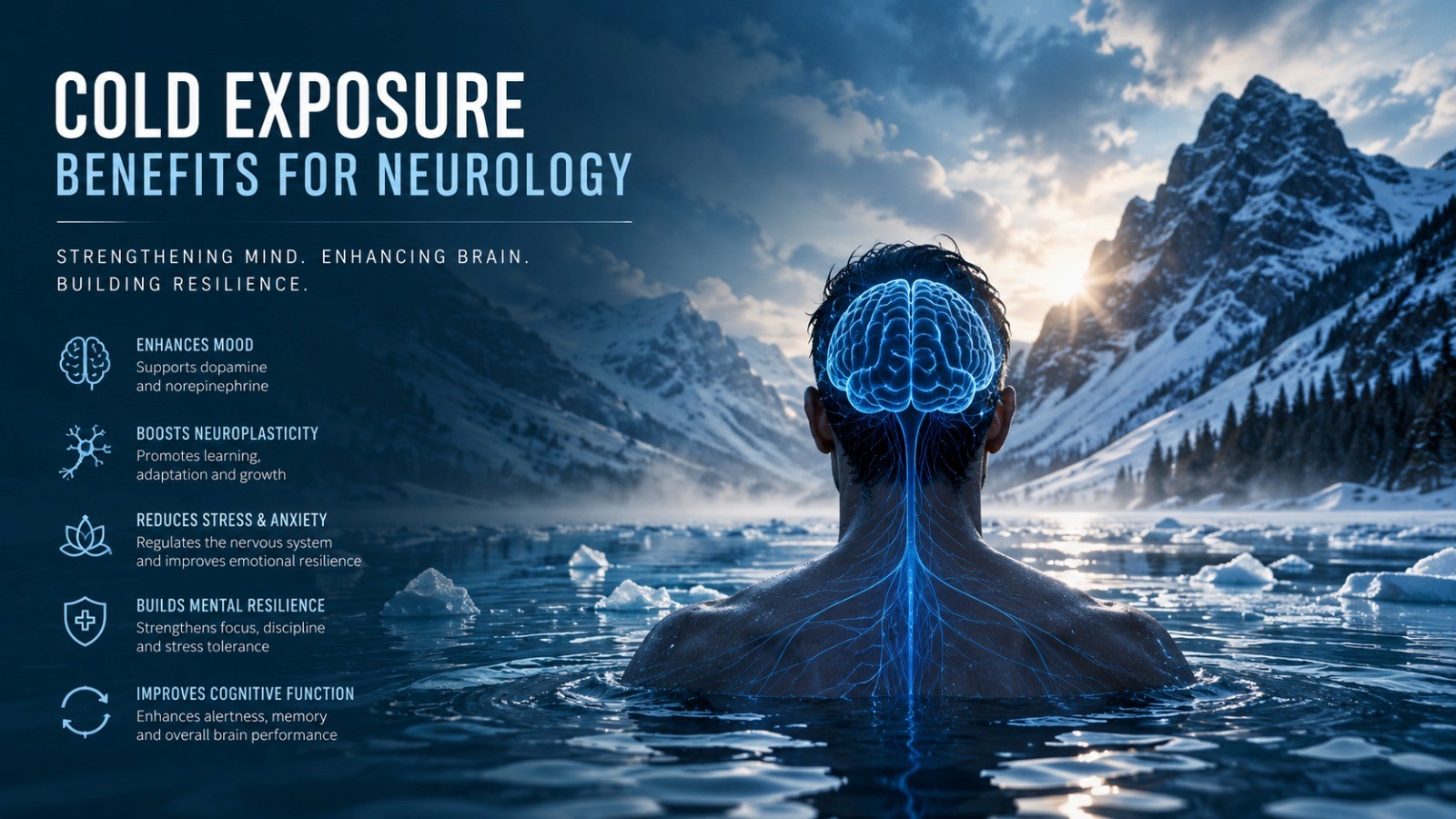
Cold showers. Ice baths. Cold plunges. You've seen the videos — athletes, biohackers, and wellness enthusiasts submerging themselves in freezing water and emerging looking strangely euphoric. But is cold exposure actually backed by science, or is it just another wellness trend?
The short answer: the biochemistry is real, and it goes much deeper than most people realise. Far from a simple recovery tool, cold exposure triggers a remarkable cascade of molecular events — many of which are now being studied for their potential role in longevity, neuroprotection, metabolic health, and inflammation management.
Here's what actually happens inside your body when you get cold.
What Is Cold Exposure?
Cold exposure — also called cold water immersion (CWI), cold hydrotherapy, or deliberate cold exposure — refers to intentionally subjecting the body to cold temperatures. This includes:
- Cold showers (finishing a shower with 30–120 seconds of cold water)
- Cold plunge baths (immersion in water at 10–15°C / 50–59°F)
- Open water swimming (rivers, oceans, or lakes in cooler months)
- Whole-body cryotherapy (cold air chambers, less effective than water due to water's 25x greater thermal conductivity)
For most of the biochemical benefits discussed below, cold water immersion is superior to cold air — water conducts heat away from the body far more efficiently, triggering a stronger physiological response.
The Immediate Response: Your Nervous System on Cold
The moment your body enters cold water, your sympathetic nervous system fires. This is not a placebo — it is a measurable, reproducible neurochemical event.
Norepinephrine spikes by up to 530%. Dopamine rises by approximately 250%. These are among the largest acute increases in these neurotransmitters that can be produced by any non-pharmacological stimulus.
To put the dopamine increase in context: it is comparable in magnitude to cocaine, without the crash, addiction risk, or legal consequences. The dopamine elevation from cold exposure is also sustained for several hours after the plunge — unlike stimulant-induced spikes, which are sharp and rapidly depleted.
The dopamine increase from cold exposure is comparable in magnitude to cocaine — without the crash, addiction risk, or legal consequences.
The dopamine elevation from cold exposure is also sustained for several hours after the plunge — unlike stimulant-induced spikes, which are sharp and rapidly depleted.
Norepinephrine drives intense alertness, focus, and anti-inflammatory signalling throughout the body. It is also a key suppressor of TNF-alpha — a master inflammatory cytokine at the root of chronic disease, joint pain, and accelerated ageing.
This is why people consistently report feeling mentally reset, more focused, and surprisingly calm in the hours after a cold plunge. The biochemistry supports the subjective experience.
The AMPK → SIRT1 → PGC-1α Axis: Cold's Longevity Pathway
This is where cold exposure becomes genuinely extraordinary — and where it overlaps with some of the most exciting research in ageing science.
AMPK: The Energy Sensor
When your body is exposed to cold stress, cellular energy drops. This activates AMPK (AMP-activated protein kinase) — the cell's master energy sensor, often described as a metabolic "low fuel" alarm. AMPK activation has been associated with longevity across multiple species and is one of the mechanisms behind the life-extending effects of caloric restriction and exercise.
SIRT1: The Longevity Switch
AMPK then activates SIRT1 — a NAD⁺-dependent enzyme and member of the sirtuin family, sometimes called the "longevity switch." SIRT1 is an evolutionarily conserved metabolic sensor that directly connects cellular stress with gene expression changes. It is the same pathway activated by fasting, resveratrol, and NMN supplementation — the molecules at the centre of modern longevity research popularised by scientists like David Sinclair.
In the context of cold exposure, SIRT1 is activated via the cAMP/PKA pathway (triggered by the adrenergic surge from cold), rapidly enhancing fatty acid oxidation — the burning of stored fat for fuel.
PGC-1α: The Mitochondrial Builder
SIRT1 then activates PGC-1α (peroxisome proliferator-activated receptor gamma coactivator 1-alpha) — arguably the most important regulator of mitochondrial biogenesis in the human body. PGC-1α instructs cells to build new mitochondria, increase oxidative metabolism, and — critically — convert white fat into metabolically active beige fat (a process called browning).
The full cascade:
This is not one mechanism — it is a coordinated, whole-body metabolic and neurological upgrade triggered by a simple thermal stress.
Brown Fat Activation and Metabolic Health
One of the most discussed benefits of cold exposure is its activation of brown adipose tissue (BAT), or brown fat.
Unlike white fat (which stores energy), brown fat burns energy to generate heat — a process called thermogenesis. Brown fat is densely packed with mitochondria (which give it its brown colour) and is highly metabolically active.
Cold exposure stimulates a sympathetically mediated increase in the rate of oxidative metabolism in brown and beige adipocytes, increasing the uptake of both glucose and free fatty acids. Sustained cold exposure — across several weeks — has been shown to increase BAT activity, reduce body fat mass, and significantly improve insulin sensitivity and glucose homeostasis.
Important nuance: Cold exposure is not a straightforward weight loss tool. Research shows that the body partly compensates for increased energy expenditure during cold by increasing appetite. The more accurate framing is that cold is a body composition and metabolic health tool — it shifts fat distribution, improves insulin sensitivity, and enhances mitochondrial function, which are all valuable health outcomes independent of the number on the scales.
Adiponectin: Cold's Anti-Diabetic Hormone
Cold exposure consistently raises circulating adiponectin — a hormone secreted by fat cells that plays a central role in insulin sensitivity, fat metabolism, and cardiovascular protection.
Low adiponectin is strongly associated with obesity, type 2 diabetes, metabolic syndrome, and cardiovascular disease. Adiponectin works through the AMPK-SIRT1 axis in brown adipose tissue, making it both a product of cold-induced activation and a driver of further metabolic benefits.
Cold water immersion is one of the most reliable non-pharmacological ways to elevate adiponectin — making it a practical tool for anyone managing blood sugar, metabolic syndrome, or cardiovascular risk.
RBM3: The Cold Shock Protein That May Protect Your Brain
This is perhaps the most extraordinary finding in cold exposure research — and the least widely known.
RBM3 (RNA Binding Motif Protein 3) is a cold shock protein produced when core body temperature drops. Unlike most proteins, which are suppressed during cold stress, RBM3 is upregulated — and its effects on the brain are remarkable.
Research published in Nature demonstrated that RBM3 prevented synapse loss in animal models of Alzheimer's and prion disease — and more strikingly, that cold-induced RBM3 could actively restore synaptic connections that had already been lost. Not just protect existing synapses, but rebuild destroyed ones.
Cambridge University scientists found markedly elevated levels of RBM3 in regular winter outdoor swimmers, while a control group who practiced Tai Chi beside the pool but never entered the water showed no increase. Critically, reducing core body temperature by just 2°F is sufficient to induce RBM3 in human brain cells.
RBM3 is now at the frontier of neurodegenerative disease research, with scientists exploring it as a potential therapeutic target for Alzheimer's and Parkinson's disease.
CIRP (Cold-Inducible RNA-Binding Protein) — RBM3's sister cold shock protein — offers complementary benefits: promoting cell survival, activating antioxidant enzymes, supporting wound healing, and potentially helping regulate circadian rhythm, which may partly explain the improved sleep quality commonly reported by regular cold immersion practitioners.
Irisin and BDNF: The Exercise-Cold Overlap
Cold exposure triggers irisin — a myokine (a hormone released by muscle tissue) normally associated with exercise. Irisin drives the browning of white fat and crosses the blood-brain barrier to stimulate BDNF (Brain-Derived Neurotrophic Factor).
BDNF is often called "fertiliser for the brain." It promotes neuroplasticity — the brain's ability to reorganise, adapt, and form new neural connections. Low BDNF is associated with depression, cognitive decline, and neurodegenerative disease. Cold exposure, like exercise, is one of the few natural interventions that reliably increases it.
Cold plunging triggers a BDNF-TrkB signalling cascade that ultimately induces RBM3 expression — creating a self-reinforcing loop of neuroprotection and synapse regeneration.
Cold Exposure and Inflammation: The Musculoskeletal Connection
For those managing musculoskeletal pain, joint inflammation, or spinal health issues, the anti-inflammatory mechanisms of cold are particularly relevant.
The norepinephrine surge from cold immersion suppresses TNF-alpha and other pro-inflammatory cytokines. TNF-alpha is a primary driver of systemic inflammation and plays a significant role in conditions including rheumatoid arthritis, disc degeneration, nerve pain, and chronic musculoskeletal disorders.
Additionally, regular cold exposure has been shown to reduce C-reactive protein (CRP) — a key marker of systemic inflammation — and interleukin levels, supporting a broader anti-inflammatory environment in the body.
Local cryotherapy (applying cold directly to an affected area) has also been shown to inhibit the breakdown of collagen and reduce the production of inflammatory prostaglandins — relevant for ligament, tendon, and disc health.
How to Actually Do It: Practical Protocol
The research points to a clear minimum effective dose:
| Method | Temperature | Duration | Frequency |
|---|---|---|---|
| Cold shower (end of shower) | As cold as possible | 30–120 seconds | Daily |
| Cold plunge / ice bath | 10–15°C (50–59°F) | 2–5 minutes | 3–5x per week |
| Open water swimming | Variable | 5–20 minutes | 2–4x per week |
Key timing principles:
- Morning cold exposure is ideal for energy, focus, and dopamine — it sets a neurochemical tone for the day
- Avoid cold within 4 hours of bedtime — the adrenergic activation can interfere with sleep onset
- Søberg Protocol: A minimum of 11 minutes of cold per week, distributed across 2–4 sessions, appears to be the threshold for meaningful metabolic adaptation
- Cold water beats cryotherapy chambers — water conducts heat 25x faster than air, producing a stronger physiological response
Beginners: Start with 30 seconds of cold water at the end of your shower. Build gradually. The anticipatory stress (the moment before you turn the tap) is itself a training stimulus for stress resilience.
What to Expect: The Timeline of Benefits
Norepinephrine +530%, dopamine +250%, alertness, mood lift
Sustained dopamine elevation, reduced inflammation markers
Improved HRV, better vagal tone, reduced stress reactivity
Measurable BAT activation, improved glucose homeostasis
Reduced body fat mass, increased adiponectin, improved insulin sensitivity
Accumulating neuroprotective benefits via RBM3, BDNF, and SIRT1
The Bottom Line
Cold exposure is one of the most biochemically potent, accessible, and free health interventions available. The science supports benefits across:
- Neurological health — dopamine, BDNF, RBM3-mediated synapse protection
- Metabolic health — SIRT1/AMPK activation, brown fat, insulin sensitivity, adiponectin
- Inflammation — TNF-alpha suppression, CRP reduction, anti-inflammatory cytokine modulation
- Nervous system resilience — HRV improvement, vagal tone, stress adaptation
- Longevity pathways — SIRT1 activation, mitochondrial biogenesis, PGC-1α
It is not a magic bullet. It won't replace sleep, nutrition, movement, or managed stress. And for weight loss specifically, it is better framed as a metabolic health and body composition tool than a direct fat-loss strategy.
But as a complement to a healthy lifestyle — particularly for those dealing with chronic inflammation, musculoskeletal pain, poor recovery, or cognitive health concerns — the biochemical case for cold exposure is compelling, and growing stronger with every research cycle.
Spinewise — Supporting your health from the spine out. For a complete assessment of your health issues, BOOK HERE
