
chiropractor near me

Serving Melbourne

for over 20 years

pain specialist melbourne

35 Churchill Ave , Maidstone

VIC 3012, Australia

icon-sticky

Serving Melbourne
for over 30 years

pain specialist melbourne

35 Churchill Ave , Maidstone, VIC 3012, Australia

Putting Out the Fire Isn't Enough: Why You Also Have to Fix What Started It

Chronic stress and overwhelm behave a lot like a bushfire. Once one gets going, it’s genuinely hard to bring back under control, and almost anything can fan it back up. Understanding that helps explain why so many people feel like they keep ending up back where they started, even after things seemed to settle down.

The Bushfire Analogy

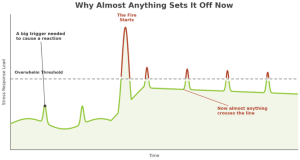
Think about how a bushfire behaves once it’s properly alight. Before it starts, it takes a real spark to get going. Once it’s burning, that’s no longer true, small gusts of wind, dry patches, things that would never have started a fire on their own, are now more than enough to make it worse. Chronic stress works in a similar way. Once it’s established, it stops behaving like an occasional flare-up and starts behaving like something that’s actively burning.

Why Almost Anything Can Set It Off Once You’re In It

This is why people often notice that things which never used to bother them suddenly feel unmanageable, a minor delay, an extra task, a bad night’s sleep. It’s not that these things have become bigger problems. It’s that there’s no buffer left to absorb them. Once the underlying fire is going, the threshold for what counts as “too much” drops dramatically.

Getting It Under Control Takes Real Work

An established fire doesn’t go out on its own just because you stop adding fuel. It takes deliberate effort to actually bring it back under control, and the same is true here. Waiting for things to calm down by themselves tends to underestimate how much active work is involved in genuinely settling an overwhelmed nervous system back down, rather than just getting through today.


You Also Have to Fix What Started It

Even once things are calmer, if the basic conditions that let it start in the first place are still there, it’s only a matter of time before something sets it off again. Bringing the immediate flare-up under control and identifying what originally allowed it to take hold are two different jobs, and both matter. Skipping the second one is one of the more common reasons people find themselves back in the same place a few months later.


Addressing Both the Fire and the Cause

If you keep finding yourself back in an overwhelmed state despite settling things down each time, it’s worth looking at both sides of the equation rather than just managing the current flare-up. Our team at Spinewise in Maidstone offers thorough, functional assessments that consider nervous system and recovery factors, as well as the underlying patterns that tend to set things off in the first place. Call us on (03) 9318 7758 or book online to talk it through.

Frequently Asked Questions

Once a stress response is already running, there’s little buffer left to absorb extra demands. Small things aren’t inherently bigger, they’re just landing on a system that’s already close to its limit.

Settling the immediate flare-up is an important first step, but it’s usually not the whole picture. If the underlying conditions that allowed it to start are still there, it tends to reignite.

It means identifying the basic, often unglamorous factors, sleep, workload, recovery time, that let the stress response take hold in the first place, rather than only addressing how you’re feeling right now.

If you’ve settled things down before but keep ending up back in the same state, that’s usually a sign the underlying cause hasn’t been addressed, even if the immediate symptoms have improved each time.

Dr Trevor Chetcuti

About the Author
Dr Trevor Chetcuti, B.Chiro.Sc, B.App.Sc (Clin), DIBAK, CNET

Dr Trevor Chetcuti is Clinical Director at Spinewise in Maidstone, holding dual degrees in Chiropractic and Clinical Science from RMIT University and a Teaching Diplomate in Applied Kinesiology through the International College of Applied Kinesiology (ICAK). He is chairman of ICAK International’s Board of Research and Standards and has spent over 20 years helping patients work through complex health, neurological and pain-related concerns.