
chiropractor near me

Serving Melbourne

for over 20 years

pain specialist melbourne

35 Churchill Ave , Maidstone

VIC 3012, Australia

icon-sticky

Serving Melbourne
for over 30 years

pain specialist melbourne

35 Churchill Ave , Maidstone, VIC 3012, Australia

The Rebound Cycle That Keeps You Reaching for a Pick-Me-Up

It sounds backwards: take stimulation away and energy improves. But there’s a flip side to that, and it explains why so many people find it hard to believe. Once the nervous system has been running on stimulation for a while, taking it away doesn’t feel good at first, it feels like exactly the wrong thing to do. That’s the rebound cycle, and it’s often the very thing keeping fatigue in place.

Why Removing Stimulation Feels Wrong at First

When someone has leaned on caffeine or other stimulation to keep their energy up, pulling it back usually brings on a craving before it brings any relief. That craving isn’t a sign the stimulation was helping, it’s the nervous system asking for the thing it’s become used to. Mistaking that craving for a genuine need is an easy trap to fall into.

Craving More Can Be a Sign You Need Less

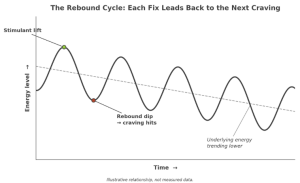
This is the counterintuitive part. The instinct when energy dips is to reach for another coffee, another pick-me-up, something to bridge the gap. But if that craving is being driven by the rebound cycle itself, giving in to it doesn’t fix the underlying fatigue, it just resets the cycle for another few hours. The craving isn’t evidence you need more stimulation. Often it’s evidence you’re stuck in the loop that’s causing the problem.
How the Cycle Keeps Itself Going

Stimulants like caffeine work by prompting the nervous system to release energy reserves it wasn’t necessarily going to spend yet. That can feel like a genuine lift, but it tends to be followed by a dip once the effect wears off, and that dip is what drives the craving for the next round. Repeated often enough, this becomes a cycle where the “fix” is also the thing perpetuating the problem it’s meant to solve.

Breaking the Cycle Without Just Pushing Through

Recognising the rebound cycle for what it is doesn’t mean simply gritting your teeth and cutting everything out overnight. For a lot of people, the craving phase settles once the nervous system adjusts to a lower baseline of stimulation, but that adjustment period is exactly where most attempts fall over. Understanding that the craving is temporary, and part of the process rather than a signal something’s gone wrong, makes it easier to see it through.

Working Out Whether You’re in the Cycle

If reaching for caffeine or another pick-me-up has become less about enjoyment and more about function, that’s worth a closer look. Our team at Spinewise in Maidstone offers thorough, functional assessments that consider lifestyle, nervous system and recovery factors, including patterns like this, that may be contributing to ongoing fatigue. Call us on (03) 9318 7758 or book online to talk it through

Frequently Asked Questions

This is often part of a rebound cycle. The nervous system has adjusted to a certain level of stimulation, and reducing it can trigger a craving before energy genuinely improves.

Not necessarily. A craving driven by the rebound cycle reflects dependence on the pattern, not a genuine underlying need for more stimulation.

It varies from person to person, but for many people the craving phase eases once the nervous system settles into a lower baseline of stimulation, rather than continuing indefinitely.

That depends on the individual and their overall pattern of stimulation, which is part of why it’s worth having your situation properly assessed rather than guessing.

Dr Trevor Chetcuti

About the Author
Dr Trevor Chetcuti, B.Chiro.Sc, B.App.Sc (Clin), DIBAK, CNET

Dr Trevor Chetcuti is Clinical Director at Spinewise in Maidstone, holding dual degrees in Chiropractic and Clinical Science from RMIT University and a Teaching Diplomate in Applied Kinesiology through the International College of Applied Kinesiology (ICAK). He is chairman of ICAK International’s Board of Research and Standards and has spent over 20 years helping patients work through complex health, neurological and pain-related concerns.