

chiropractor near me

Serving Melbourne

for over 20 years

pain specialist melbourne

35 Churchill Ave , Maidstone

VIC 3012, Australia

icon-sticky

Serving Melbourne
for over 30 years

pain specialist melbourne

35 Churchill Ave , Maidstone, VIC 3012, Australia

Why Sleep Debt Catches Up With You Eventually

A rough night’s sleep doesn’t always feel like a big deal the next day. You might feel emotionally fine, get through your to-do list, even have a genuinely good day. But feeling fine isn’t the same as your body having absorbed that sleep loss without cost. The bill for sleep debt doesn’t always arrive the next morning, it tends to arrive later, and it tends to arrive as fatigue.

One Bad Night Rarely Feels Like the Problem

If you lose three or four hours of sleep on a given night, you can often push through the next day without much obvious impact. That’s part of what makes sleep debt so easy to underestimate, the immediate consequences are often mild enough to write off, and the day goes on largely as normal. It’s tempting to conclude that because you felt okay, no real cost was incurred.

Feeling Fine Isn’t the Same as Being Unaffected

Underneath a day that feels emotionally normal, the body can still be carrying the physiological load of that lost sleep. The nervous system doesn’t necessarily reset itself just because your mood held up. That gap, between how you feel and what your system is actually managing, is exactly where sleep debt tends to build without being noticed.
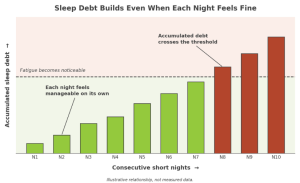
Why It’s Debt, Not a One-Off Cost

The reason “sleep debt” is a useful way to think about this is that, like any debt, it accumulates. One short night rarely causes a visible problem. But short nights repeated across weeks or months don’t simply cancel each other out, they stack. Eventually the accumulated load outpaces what the body can quietly absorb, and that’s usually when fatigue stops being occasional and starts being constant.


Everything You Do Is a Stress on the Body

It helps to think of sleep loss as one stress among many that your body is managing, rather than something separate. Whether you cope with a given demand or not is often about how much capacity you have left, not whether the demand itself was severe. A body that’s been running a sleep deficit for a while simply has less capacity in reserve when the next demand, physical, mental or otherwise, comes along.


Working Out How Much You’re Actually Carrying

If you’ve been getting by on less sleep for a while and telling yourself it’s fine because you still feel okay day to day, it’s worth having a proper look at what your body is actually managing underneath that. Our team at Spinewise in Maidstone offers thorough, functional assessments that consider sleep, recovery and nervous system factors that may be contributing to accumulated fatigue. Call us on (03) 9318 7758 or book online to talk it through.

Frequently Asked Questions

Not necessarily. Feeling emotionally fine doesn’t mean the physiological cost of that sleep loss has been avoided, it’s often still being carried by the body even when mood and function seem normal.

Short nights of sleep don’t cancel each other out. Repeated across weeks or months, that lost sleep tends to accumulate, gradually reducing the capacity your body has in reserve.

Coping with a given night’s sleep loss isn’t the same as having no cost at all. Once accumulated sleep debt outpaces what your body can quietly manage, fatigue tends to become more constant rather than occasional.

Not from how you feel day to day alone. It’s worth having your sleep, recovery and nervous system load properly assessed if you suspect you’ve been running a deficit for a while.

Dr Trevor Chetcuti

About the Author
Dr Trevor Chetcuti, B.Chiro.Sc, B.App.Sc (Clin), DIBAK, CNET

Dr Trevor Chetcuti is Clinical Director at Spinewise in Maidstone, holding dual degrees in Chiropractic and Clinical Science from RMIT University and a Teaching Diplomate in Applied Kinesiology through the International College of Applied Kinesiology (ICAK). He is chairman of ICAK International’s Board of Research and Standards and has spent over 20 years helping patients work through complex health, neurological and pain-related concerns.