

chiropractor near me

Serving Melbourne

for over 20 years

pain specialist melbourne

35 Churchill Ave , Maidstone

VIC 3012, Australia

icon-sticky

Serving Melbourne
for over 30 years

pain specialist melbourne

35 Churchill Ave , Maidstone, VIC 3012, Australia

Why Some People Feel Every Heartbeat and Gut Signal (And Others Don't)

Some people can feel their own heart rate without touching their pulse, or notice the moment their digestion is doing something wrong. Others could have the exact same physical symptom, in the same moment, and register almost nothing. The difference isn’t just personality. It comes down to how well the brain reads signals from inside the body, a sense called interoception.

What Interoception Actually Is

Interoception is your sense of what’s happening inside your own body, separate from the five senses that pick up the outside world. It’s how you know you’re hungry before your stomach growls, how you notice your heart rate climbing before you check a device, and how you pick up early tension building in your gut or chest. Some people have very accurate interoception. Others have poor interoception, and either extreme changes how someone experiences their own health day to day.

The Insular Cortex: Your Brain’s Body-Signal Hub

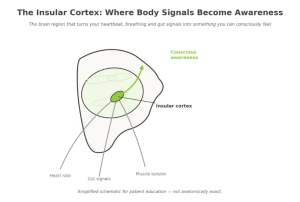
The area doing most of this work is the insular cortex, a region folded deep inside the brain that receives input from the heart, lungs, gut and muscles and turns it into something you can consciously notice. It’s one of the busiest hubs for internal body signals, and how active or sensitive someone’s insular cortex is plays a large part in whether they feel every internal fluctuation or barely notice any of them.

Why a Jaw Correction Can Change Things So Quickly

When we assess and correct a jaw restriction using Applied Kinesiology, we’re not just working on the joint, we’re changing the sensory input travelling up the trigeminal pathway into the brainstem. For someone whose nervous system is already overloaded by an active migraine, taking one hypersensitive input out of the mix can be enough to shift the pattern, sometimes within minutes.

It fits the broader pattern behind this series: the nervous system isn’t reacting to one thing in isolation, it’s responding to a total load of sensory input. Reduce one contributing input and the whole system can settle, even before anything else about the migraine has been addressed.
Why Some Nervous Systems Turn the Volume Up

For some people, this system is simply wired to run louder. They pick up a racing heart, a tight jaw, or a change in digestion earlier and more intensely than most people around them. This isn’t a flaw, it’s a difference in how much internal sensory information is reaching conscious awareness. It also means their nervous system has more raw information to process at any given moment, on top of everything coming in from the outside world.


When High Interoception Becomes Overstimulation

Stronger interoception fits directly into the pattern behind this series: an already busy nervous system with heightened body awareness on top of normal daily stimulation can tip into overload more easily. Someone might describe it as constantly monitoring their own body, feeling every twinge, every skipped heartbeat, every gut symptom, and struggling to switch that awareness off. That constant internal monitoring is itself a form of sensory load, even when nothing is medically wrong.


Where This Fits at Spinewise

At our Maidstone clinic, understanding how a person’s nervous system processes internal and external signals is part of how we approach hypersensitivity and overstimulation more broadly, alongside physical assessment. If you notice you feel everything happening in your body more intensely than the people around you, or you’ve never been able to switch that awareness off, it’s worth having your nervous system function assessed rather than assuming it’s just anxiety or oversensitivity.

Curious what’s behind how strongly you feel your own body’s signals? Book an assessment with our team at https://pracsuite.bookings.pracsuite.com/guest and we’ll talk through what’s actually going on.

Frequently Asked Questions

Interoception is the sense that lets you perceive what’s happening inside your own body, like your heart rate, breathing, digestion and muscle tension, separate from the five senses that process the outside world.

Not on its own. Strong interoception simply means more internal signals are reaching conscious awareness. It can become a problem when it adds to an already overloaded nervous system, contributing to a general sense of being overstimulated.

Yes. How clearly someone perceives internal body signals isn’t fixed, and it can shift along with overall nervous system load, stress and other contributing factors.

We look at nervous system function as part of a broader assessment, alongside physical and postural factors, rather than treating body awareness in isolation.

Dr Trevor Chetcuti

About the Author
Dr Trevor Chetcuti, B.Chiro.Sc, B.App.Sc (Clin), DIBAK, CNET

Dr Trevor Chetcuti is Clinical Director at Spinewise in Maidstone, holding dual degrees in Chiropractic and Clinical Science from RMIT University and a Teaching Diplomate in Applied Kinesiology through the International College of Applied Kinesiology (ICAK). He is chairman of ICAK International’s Board of Research and Standards and has spent over 20 years helping patients work through complex health, neurological and pain-related concerns.