

chiropractor near me

Serving Melbourne

for over 20 years

pain specialist melbourne

35 Churchill Ave , Maidstone

VIC 3012, Australia

icon-sticky

Serving Melbourne
for over 30 years

pain specialist melbourne

35 Churchill Ave , Maidstone, VIC 3012, Australia

Why You Don't Normally Feel Your T-Shirt (And What That Has to Do With Inhibition)

Right now, unless you’re thinking about it, you probably can’t feel your t-shirt on your skin, or a watch on your wrist, or your feet inside your shoes. That’s not because there’s no sensation there. It’s because your brain is actively blocking it out, a process called inhibition, and it’s a key piece of the picture we’ve been building throughout this series.

Inhibition Is About Blocking, Not Just Filtering

We’ve talked elsewhere in this series about how the brain filters an enormous amount of sensory information. Inhibition is closely related, but it’s a slightly different job. Filtering decides what deserves attention. Inhibition is the active process of blocking out input that’s already been identified as irrelevant, so it stops demanding attention altogether. It’s less “not noticing” and more “actively suppressing an ongoing signal.”

The T-Shirt Test

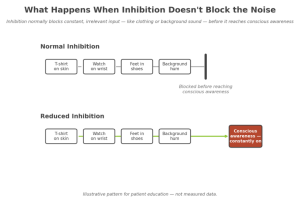
Try it right now. Can you feel the seam of your sock? The collar of your shirt against your neck? If you’re wearing a microphone or a lanyard, can you feel it sitting on your chest? The sensory receptors in your skin are still firing the whole time, that input is real and constant, but your brain has decided it isn’t currently relevant and inhibits it before it reaches conscious awareness. This is normal, healthy inhibition at work, happening constantly, all day, without any effort on your part.
What Happens When Inhibition Doesn’t Work as Well

For some people, this process doesn’t work as efficiently. Ordinary, constant input, clothing tags, seams, certain fabrics, background sensations, keeps registering instead of fading into the background the way it should. It’s genuinely exhausting, because things that should require zero effort to ignore keep demanding attention instead, all day long.


Why This Matters Across the Whole Picture

Inhibition underpins a lot of what we’ve covered in this series. Filtering, regulation capacity and attention all depend on inhibition working well in the background. If inhibition is inefficient, more raw sensory information keeps reaching conscious awareness than it should, adding directly to the overall load the nervous system has to manage.


Where This Fits at Spinewise

At our Maidstone clinic, understanding how well someone’s inhibition is working is part of the broader nervous system picture we look at, alongside sensory sensitivity, filtering and regulation capacity. It’s often one of the more overlooked pieces, but it can explain a lot about why ordinary daily sensations feel unusually persistent or hard to ignore for some people.

Notice you can’t seem to “tune out” things like clothing tags or background noise the way other people do? Book an assessment with our team at https://pracsuite.bookings.pracsuite.com/guest and we’ll look at what’s actually going on with your nervous system.

Frequently Asked Questions

Inhibition is dynamic, not constant. Fatigue, stress or an already overloaded nervous system can all make inhibition less effective, so sensations that are normally blocked out can suddenly register again.

Not necessarily. Inhibition efficiency exists on a spectrum for everyone. A proper assessment is the only way to understand what’s actually driving a particular pattern for you.

It isn’t fixed. Inhibition is affected by overall nervous system load, so addressing what’s contributing to that load can support how well inhibition works.

We look at how well someone’s nervous system is inhibiting irrelevant input as part of a broader assessment, alongside sensory sensitivity, filtering and regulation.

Dr Trevor Chetcuti

About the Author
Dr Trevor Chetcuti, B.Chiro.Sc, B.App.Sc (Clin), DIBAK, CNET

Dr Trevor Chetcuti is Clinical Director at Spinewise in Maidstone, holding dual degrees in Chiropractic and Clinical Science from RMIT University and a Teaching Diplomate in Applied Kinesiology through the International College of Applied Kinesiology (ICAK). He is chairman of ICAK International’s Board of Research and Standards and has spent over 20 years helping patients work through complex health, neurological and pain-related concerns.