
chiropractor near me

Serving Melbourne

for over 20 years

pain specialist melbourne

35 Churchill Ave , Maidstone

VIC 3012, Australia

icon-sticky

Serving Melbourne
for over 30 years

pain specialist melbourne

35 Churchill Ave , Maidstone, VIC 3012, Australia

Why Telling an Overstimulated Brain to "Calm Down" Doesn't Work

A lot of people get told to just calm down. “You’re fine, can’t you see the test came back normal?” It’s well-meaning advice, but it treats calming down as a simple choice. For a lot of people, it isn’t that simple, and no amount of reassurance changes that.

What “Just Calm Down” Assumes (And Gets Wrong)

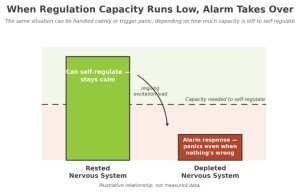
Telling someone to calm down assumes their nervous system has spare capacity sitting there, ready to be switched on with the right words or the right facts. As we’ve covered elsewhere in this series, a huge amount of sensory and internal input is being filtered and regulated constantly, mostly without anyone noticing. That regulation isn’t unlimited. When it’s already stretched thin, being told the facts don’t support how you’re feeling doesn’t give the nervous system any capacity back.

When the Brain Is Too Tired to Regulate Itself

If the nervous system has been running at a high level of excitation for a while, whether that’s from ongoing stress, poor sleep, constant sensory input, or all of it stacked together, its capacity to regulate a new situation calmly starts to run out. At that point, even a genuinely low-risk moment, like waiting on a normal test result, can trigger a full alarm response. The brain isn’t being irrational. It’s simply too depleted to do the regulating job it would normally do without any effort at all.

Why Logic Doesn’t Fix It

This is why reassurance so often doesn’t land. Being told “there’s nothing to worry about” is a logical, conscious-level argument, but the alarm response is being generated well below that level. It’s a bit like telling an exhausted muscle to just lift the weight anyway. The information is correct. It’s just not the kind of input that restores capacity.

Solve the Excitation Problem First

The more useful question usually isn’t “why can’t you just calm down,” it’s “what’s been driving the excitation load in the first place.” That might be ongoing sensory overload, unresolved physical stress, poor sleep, or several contributing inputs at once, and it’s different for everyone. Reducing that load is usually what needs to happen before the nervous system has enough spare capacity to regulate calmly again. Once that capacity comes back, the same situation that used to trigger alarm often doesn’t anymore.

Where This Fits at Spinewise

At our Maidstone clinic, this is part of why we look at what’s actually driving someone’s nervous system excitation rather than only addressing how they’re reacting in the moment. It ties together with the other pieces we’ve covered in this series, sensory sensitivity, internal body awareness, and filtering capacity, as part of understanding the full picture of what a person’s nervous system is dealing with.

Find that “just calm down” has never really worked for you? Book an assessment with our team at https://pracsuite.bookings.pracsuite.com/guest and we’ll look at what’s actually driving the excitation, not just the reaction to it.

Frequently Asked Questions

Because the alarm response isn’t generated at the logical, conscious level. When the nervous system’s regulation capacity is already used up, facts and reassurance don’t restore that capacity.

Not necessarily. Anxiety can have a number of contributing factors. This is specifically about how much regulation capacity the nervous system has left, which is one piece of a larger picture. A proper assessment is the only way to know what’s actually driving it for you.

It means identifying and addressing whatever is keeping the nervous system running at a high level, whether that’s sensory overload, physical stress, sleep, or something else, rather than only focusing on the panic response itself.

We look at what’s contributing to someone’s overall nervous system load as part of a broader assessment, rather than treating the alarm response as a stand-alone issue.

Dr Trevor Chetcuti

About the Author
Dr Trevor Chetcuti, B.Chiro.Sc, B.App.Sc (Clin), DIBAK, CNET

Dr Trevor Chetcuti is Clinical Director at Spinewise in Maidstone, holding dual degrees in Chiropractic and Clinical Science from RMIT University and a Teaching Diplomate in Applied Kinesiology through the International College of Applied Kinesiology (ICAK). He is chairman of ICAK International’s Board of Research and Standards and has spent over 20 years helping patients work through complex health, neurological and pain-related concerns.