
chiropractor near me

Serving Melbourne

for over 20 years

pain specialist melbourne

35 Churchill Ave , Maidstone

VIC 3012, Australia

icon-sticky

Serving Melbourne
for over 30 years

pain specialist melbourne

35 Churchill Ave , Maidstone, VIC 3012, Australia

Why Something as Simple as Tennis Can Help Calm an Overstimulated Nervous System

Throughout this series we’ve talked about what happens when the nervous system’s regulation capacity runs low. The more encouraging side of that same coin is that some very ordinary activities can genuinely help support that regulation, and one of the more surprising ones is a fast game of hand-eye coordination, like tennis or table tennis.

Hand-Eye Coordination Asks More of the Brain Than It Looks Like

Tracking a fast-moving ball and coordinating a precise motor response to it in real time asks the brain to integrate visual input, timing and movement all at once. That’s the same kind of integration and regulation work involved in filtering and making sense of everyday sensory input, which we’ve covered elsewhere in this series. Practising it through something like tennis or table tennis can help support those same underlying mechanisms.

Why It Can Work Without Formal Therapy

For a lot of people, this kind of improvement doesn’t require a clinical program. Simply playing regularly, at a level that’s genuinely challenging, can noticeably support how well someone’s nervous system handles input and stays regulated. It’s a reminder that some of the most useful tools for nervous system regulation are ordinary and already available, not something that has to be prescribed.

More Isn’t Always Better

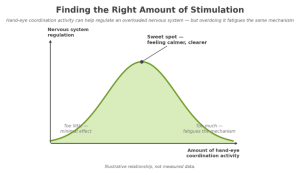
There’s an important catch. The same activity that can help regulate the nervous system can also fatigue it if there’s too much of it. Hand-eye coordination work draws on the same mechanisms it’s helping to strengthen, so pushing it too hard or too often can leave someone feeling more drained rather than clearer. This fits the pattern we keep coming back to in this series: the goal isn’t maximum stimulation, it’s finding the right amount for your own nervous system at the time.


What This Can Feel Like

It’s common to hear people describe feeling noticeably calmer and clearer after this kind of activity, more able to think straight and less wound up than before they started. That’s not the same for everyone, and it isn’t a substitute for addressing a genuinely overloaded nervous system, but for a lot of people it’s a simple, accessible way to support regulation day to day.


Where This Fits at Spinewise

At our Maidstone clinic, part of a nervous system assessment is understanding what kind of stimulation someone’s system responds well to, and how much of it is actually helpful versus too much. That’s different for everyone, and it ties together with everything else we’ve covered in this series about sensory sensitivity, internal awareness, filtering, and regulation capacity.

Not sure what your own nervous system needs more or less of? Book an assessment with our team at khttps://pracsuite.bookings.pracsuite.com/guest and we’ll help you work out what’s actually useful for you.

Frequently Asked Questions

Activities that combine fast visual tracking with precise, real-time movement draw on the same brain mechanisms involved in regulating and integrating everyday sensory input, so practising them can help support that regulation.

Not necessarily. It can be a helpful, accessible tool for many people, but it isn’t a substitute for a proper assessment if someone’s nervous system is significantly overloaded.

It’s different for everyone. The same activity that helps regulate the nervous system can fatigue it if it’s overdone, so it’s worth paying attention to how you feel afterwards rather than assuming more is always better.

That’s really what a proper assessment is for, understanding what kind of stimulation someone’s system responds well to and how much is genuinely helpful.

Dr Trevor Chetcuti

About the Author
Dr Trevor Chetcuti, B.Chiro.Sc, B.App.Sc (Clin), DIBAK, CNET

Dr Trevor Chetcuti is Clinical Director at Spinewise in Maidstone, holding dual degrees in Chiropractic and Clinical Science from RMIT University and a Teaching Diplomate in Applied Kinesiology through the International College of Applied Kinesiology (ICAK). He is chairman of ICAK International’s Board of Research and Standards and has spent over 20 years helping patients work through complex health, neurological and pain-related concerns.