
chiropractor near me

Serving Melbourne

for over 20 years

pain specialist melbourne

35 Churchill Ave , Maidstone

VIC 3012, Australia

icon-sticky

Serving Melbourne
for over 30 years

pain specialist melbourne

35 Churchill Ave , Maidstone, VIC 3012, Australia

Why Spending Time in Nature Can Help Reset an Overstimulated Nervous System

After talking through active tools like hand-eye coordination activity earlier in this series, one of the simplest and most accessible ways to help an overloaded nervous system settle is also one of the easiest to overlook: spending time in nature and letting your eyes focus into the distance instead of up close.

Why Close-Range Focus Adds to the Load

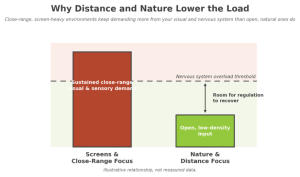
Screens, reading and most indoor work demand sustained close-range visual focus for hours at a time. That constant near-focus is itself a form of ongoing sensory demand, on top of everything else the nervous system is already processing. Most modern environments keep people locked into this close-range mode for the vast majority of the day, with very little built-in break from it.

Distance Vision Gives the System a Break

Looking out into the distance, across a park, a beach, or any open horizon, asks the visual system to work in a completely different way to reading a screen or a page. That shift away from sustained close focus gives part of the visual and nervous system a genuine break, rather than just a change of scenery.

Nature Reduces the Density of Input, Not Just the Distance

It’s not only about how far away you’re looking. Natural environments also tend to have far less densely packed sensory information than built environments, fewer sharp edges, less artificial lighting, no notifications competing for attention. Being in nature reduces the sheer amount of input the nervous system has to process at any given moment, which is a different kind of relief to distance vision, but works alongside it.

Reconnecting to Our Groundings

Basic nature exposure is, in a sense, closer to the baseline environment the nervous system evolved to handle without much effort. Stepping away from constant close-range, artificial, high-density input, even briefly, gives the regulation systems we’ve talked about throughout this series a genuine chance to recover rather than staying switched on.

Where This Fits at Spinewise

At our Maidstone clinic, we talk to patients about accessible, everyday tools like this alongside more structured nervous system assessment. It ties in with everything else we’ve covered in this series, sensory sensitivity, internal awareness, filtering capacity and regulation, as one more input that’s genuinely within most people’s control.

Notice you feel better after time outdoors but can’t seem to switch off indoors? Book an assessment with our team at https://pracsuite.bookings.pracsuite.com/guest and we’ll help you understand what your nervous system actually needs.

Frequently Asked Questions

Screens demand sustained close-range visual focus, which is an ongoing form of sensory input. Over hours, that adds to the overall load the nervous system is managing, alongside everything else going on.

There’s no fixed amount that works for everyone. Even short breaks looking into the distance or spending time outdoors can make a noticeable difference for some people, while others need more.

Not exactly. This is more about the close-range visual focus and sensory density of screen use generally, rather than the specific wavelength of light involved.

That’s part of what a proper nervous system assessment looks at, understanding how much of your day is spent in close-range, high-density environments and whether that’s contributing to how overstimulated you feel.

Dr Trevor Chetcuti

About the Author
Dr Trevor Chetcuti, B.Chiro.Sc, B.App.Sc (Clin), DIBAK, CNET

Dr Trevor Chetcuti is Clinical Director at Spinewise in Maidstone, holding dual degrees in Chiropractic and Clinical Science from RMIT University and a Teaching Diplomate in Applied Kinesiology through the International College of Applied Kinesiology (ICAK). He is chairman of ICAK International’s Board of Research and Standards and has spent over 20 years helping patients work through complex health, neurological and pain-related concerns.