
When a Post-Exercise Crash Points to Something More Than Tiredness
Feeling tired after exercise is completely normal. But for some people, even mild activity leads to something well beyond ordinary tiredness, a delayed, disproportionate crash that can last for days. This particular pattern is worth understanding on its own terms, because it points somewhere quite specific.
Being Tired After Exercise Is Normal. This Is Different.
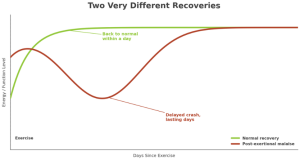
Ordinary post-exercise fatigue is proportional to what you did, and it settles with a bit of rest. What we’re describing here is different in kind, not just degree. Some people do a fairly modest amount of activity and, rather than feeling tired and then recovering, they crash. The exhaustion that follows is out of proportion to the effort, and it doesn’t resolve the way normal tiredness does.

What This Kind of Crash Actually Looks Like
This is often called post-exertional malaise. It doesn’t necessarily show up immediately, it can hit the next day or even the day after that, and it can last well beyond the timeframe you’d expect from the activity itself. People often describe it as feeling flu-like, mentally foggy, and simply unable to function at their usual level, sometimes for days.

Why This Pattern Points to Something More Specific
This particular crash pattern, exercise triggering a delayed, disproportionate, prolonged decline, is one of the more distinguishing features associated with chronic fatigue syndrome. It’s a different picture to general burnout or run-down fatigue, and it’s not simply a matter of being unfit or deconditioned. Importantly, pushing through with more exercise, which can genuinely help general fatigue in other contexts, tends to make this specific pattern worse rather than better.
Why Getting the Right Picture Matters
Because the right approach depends heavily on what’s actually going on, correctly recognising this pattern matters. Generic advice to “push through” or gradually build up exercise tolerance can be counterproductive here in a way it wouldn’t be for ordinary fatigue. This is exactly the kind of pattern worth having properly assessed rather than managed by guesswork.
Getting a Clearer Picture
If exercise reliably triggers a crash like this for you, it’s worth raising with a healthcare professional, who can properly assess for chronic fatigue syndrome and rule out other possible causes. Separately, our team at Spinewise in Maidstone offers thorough, functional assessments that look at broader nervous system and recovery factors, which can sit alongside a proper diagnosis rather than in place of one. Call us on (03) 9318 7758 or book online to talk it through.
Frequently Asked Questions
Ordinary tiredness is proportional to the effort and resolves with rest. Post-exertional malaise is a delayed, disproportionate crash that can last for days and doesn’t follow the usual recovery pattern.
Not necessarily, but this specific pattern is one of the more distinguishing features associated with it, and it’s genuinely worth having properly assessed rather than assumed either way.
Because this isn’t simply deconditioning. For this specific pattern, exercise can act as a trigger for the crash itself, rather than something the body gradually adapts to.
Raise it with a healthcare professional for a proper assessment rather than continuing to push through or assuming it will resolve with more fitness work.
About the Author
Dr Trevor Chetcuti, B.Chiro.Sc, B.App.Sc (Clin), DIBAK, CNET
Dr Trevor Chetcuti is Clinical Director at Spinewise in Maidstone, holding dual degrees in Chiropractic and Clinical Science from RMIT University and a Teaching Diplomate in Applied Kinesiology through the International College of Applied Kinesiology (ICAK). He is chairman of ICAK International’s Board of Research and Standards and has spent over 20 years helping patients work through complex health, neurological and pain-related concerns.


