

The Fatigue That Comes Down to Biochemistry, Not Behaviour
Most conversations about fatigue focus on sleep, stress and workload, and for good reason, those matter. But some fatigue has a more basic driver underneath it, one that has little to do with what someone is or isn’t doing, and a lot more to do with biochemistry.
How Free Radicals Interfere With Energy Production
High levels of free radicals in the body can inhibit specific energy pathways used by brain cells. The result is that the brain doesn’t produce energy as efficiently as it should, and one of the flow-on effects of that can be fatigue. Push those pathways hard enough for long enough and they simply stop working as well as they’re meant to.

This Kind of Fatigue Isn’t About What You’re Doing Wrong
This is an important distinction from a lot of what gets discussed around fatigue. If the underlying driver is this kind of biochemical load rather than habits or behaviour, then it’s not something that shows up because of a personal failing, poor discipline, or not trying hard enough. It can be present potentially regardless of what someone is doing.
Why Daily Exposure Adds Up
Free radicals aren’t unusual or rare, producing them is a normal part of everyday life and general metabolism. For some people, ordinary day-to-day exposure is simply enough, over time, to start affecting these energy pathways. It doesn’t necessarily take anything out of the ordinary for this to become a genuine contributor to how tired someone feels.
Genetics Can Determine How Fast You Get There
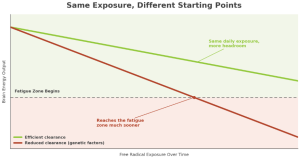
Not everyone clears free radicals from their system at the same rate. Some people are genetically less efficient at it, which means they can reach this kind of fatigue sooner than someone with the same day-to-day exposure but a more efficient clearance system. Again, this isn’t about what anyone is doing, it’s about how their system is built to handle a normal, everyday load.
Looking at the Biochemical Side of Fatigue
If your fatigue doesn’t seem to line up with your sleep, stress or workload the way you’d expect, it’s worth considering that the underlying driver might sit at this more biochemical level. Our team at Spinewise in Maidstone offers thorough, functional assessments that look at broader nervous system and recovery factors that may be contributing, rather than assuming lifestyle is always the whole story. Call us on (03) 9318 7758 or book online to talk it through.
Frequently Asked Questions
Yes. Biochemical factors, like free radicals interfering with energy pathways in the brain, can contribute to fatigue independently of sleep, stress or workload.
They’re a normal by-product of everyday metabolism and exposure. At higher levels, they can interfere with the specific energy pathways brain cells rely on to function well.
Genetics can play a role in how efficiently someone clears free radicals from their system. Less efficient clearance can mean reaching this kind of fatigue sooner, even with similar day-to-day exposure.
It’s worth having it properly assessed rather than only adjusting sleep or workload, since those changes alone may not address a biochemical driver sitting underneath the fatigue.
About the Author
Dr Trevor Chetcuti, B.Chiro.Sc, B.App.Sc (Clin), DIBAK, CNET
Dr Trevor Chetcuti is Clinical Director at Spinewise in Maidstone, holding dual degrees in Chiropractic and Clinical Science from RMIT University and a Teaching Diplomate in Applied Kinesiology through the International College of Applied Kinesiology (ICAK). He is chairman of ICAK International’s Board of Research and Standards and has spent over 20 years helping patients work through complex health, neurological and pain-related concerns.


