chiropractor near me

Serving Melbourne

for over 20 years

pain specialist melbourne

35 Churchill Ave , Maidstone

VIC 3012, Australia

icon-sticky

Serving Melbourne
for over 30 years

pain specialist melbourne

35 Churchill Ave , Maidstone, VIC 3012, Australia

Adaptation vs Survival: Why Pushing a Low-Intensity Session Too Hard Backfires

Even something as unassuming as a 30 or 40-minute run has a limit to how often your body can absorb it before the whole process changes character. Cross that limit and you’re no longer training — you’re just surviving.

What Happens After a Low-Intensity Session

Take something moderate — a four or five kilometre run lasting 30 to 40 minutes. It doesn’t look like an intense session, but when you get home, your physiology still needs to adapt to it, and that adaptation takes time. This is true even at low intensity: the body has to process the stimulus, and that processing isn’t instant just because the effort wasn’t maximal.
Frequency Within Your Tolerance Is the Real Driver

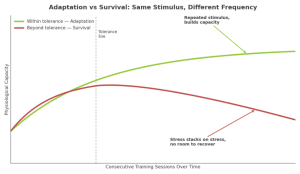
Because adaptation takes time, how often you repeat that stimulus — within what your body can actually tolerate — is what drives the improvement. The more frequently you do it inside that tolerance window, the better the adaptation becomes. This is why regular, moderate sessions tend to build capacity so reliably: they give the body repeated opportunities to adapt without ever asking it to do more than it can process.

When You Cross the Line, It Stops Being Adaptation

The problem starts when you keep pushing past that tolerance — session after session, without enough room to process what came before. At that point, you’re no longer creating adaptation; you’re just creating stress on top of stress on top of stress, with the body never getting the chance to catch up and recover. It’s a completely different situation to the one that builds fitness, even though the sessions themselves might look similar from the outside. It’s no longer about adaptation. It’s about survival.

Knowing Where Your Own Line Is

The same session can be productive or counterproductive depending on how it fits into everything else you’re doing and how much recovery you’re actually getting between efforts. If you’re not sure whether your current training frequency sits inside your tolerance or has tipped into constant stress, that’s worth working through properly. Our team at Spinewise in Maidstone can help you find where that line actually is for you — call us on (03) 9318 7758 or book online.

Frequently Asked Questions

Yes. Even a low-intensity session, like a 30 to 40-minute run, requires the body to process and adapt to the stimulus, and that process isn’t instant just because the effort felt manageable.

The clearest signs are accumulating fatigue, flattening performance, and feeling like you’re constantly recovering rather than progressing. If sessions keep stacking without enough recovery between them, that’s a sign you’ve crossed your tolerance line.

Only within your tolerance levels. More frequency drives better adaptation up to a point — beyond that point, added frequency just adds stress without giving the body room to recover and improve.

Yes. It’s not about how hard any single session is, but about whether the accumulated stress across sessions is being matched by enough recovery. Repeated moderate sessions without adequate recovery can create the same problem as repeated hard ones.

Dr Trevor Chetcuti

About the Author
Dr Trevor Chetcuti, B.Chiro.Sc, B.App.Sc (Clin), DIBAK, CNET

Dr Trevor Chetcuti is Clinical Director at Spinewise in Maidstone, holding dual degrees in Chiropractic and Clinical Science from RMIT University and a Teaching Diplomate in Applied Kinesiology through the International College of Applied Kinesiology (ICAK). He is chairman of ICAK International’s Board of Research and Standards and has spent over 20 years helping patients work through complex health, neurological and pain-related concerns.