

Why Correcting Your Jaw Can Help Calm a Migraine Already in Progress
A migraine that’s already building by the time someone notices it can feel like there’s nothing left to do but wait it out. But one of the inputs feeding that intensity sits closer to the jaw than most people expect, and it’s why, every so often, correcting a jaw restriction can take the edge off a migraine that’s already underway.
The Trigeminal Nerve Is a Bigger Deal Than It Sounds
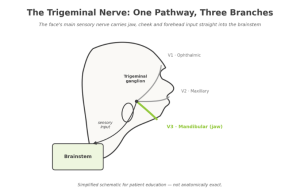
The trigeminal nerve is the main sensory nerve for the face, jaw and much of the head, and it’s one of the most heavily implicated structures in migraine research. It carries an enormous amount of sensory traffic into the brainstem, and when that traffic is already elevated, as it tends to be during a migraine, even a small additional load from the jaw can be enough to help keep the pain cycle going.
This is one reason migraine and jaw problems, including TMJ dysfunction, so often turn up in the same patients. They’re feeding into overlapping nerve pathways, not just sitting next to each other anatomically.

Why a Jaw Correction Can Change Things So Quickly
When we assess and correct a jaw restriction using Applied Kinesiology, we’re not just working on the joint, we’re changing the sensory input travelling up the trigeminal pathway into the brainstem. For someone whose nervous system is already overloaded by an active migraine, taking one hypersensitive input out of the mix can be enough to shift the pattern, sometimes within minutes.
It fits the broader pattern behind this series: the nervous system isn’t reacting to one thing in isolation, it’s responding to a total load of sensory input. Reduce one contributing input and the whole system can settle, even before anything else about the migraine has been addressed.
What This Can Look Like in the Room
It’s not unusual for a patient to come in with a migraine that started that morning, describe it as already quite severe, and, after a jaw correction, notice the intensity easing before they’ve left the table. Not every case responds this way, and a jaw correction isn’t a stand-alone treatment for migraine. But when the trigeminal pathway is genuinely contributing, the change can be immediate enough that people notice it happening in real time.
This is exactly why a proper assessment matters. Jaw involvement is one of several possible contributing patterns in migraine and headache presentations, and identifying whether it’s relevant to you is part of what a structured Applied Kinesiology assessment is for.
Where This Fits at Spinewise
At our Maidstone clinic, jaw and cranial assessment is a standard part of how we work through headache and migraine presentations, alongside the neck, upper back and broader nervous system factors that can all feed the same picture. If migraines or recurring headaches are something you’re managing, it’s worth having your jaw checked as part of a full assessment rather than assuming it’s unrelated.
Ready to find out if your jaw is part of the picture? Book an assessment with our team at https://pracsuite.bookings.pracsuite.com/guest and we’ll walk through what’s actually driving your migraines.
Frequently Asked Questions
Not necessarily. Jaw involvement is one of several possible contributing factors in migraine, and it can play a role even without a formal TMJ diagnosis. A proper assessment is the only way to know if it’s relevant for you.
Not on its own, and not for everyone. Migraine is a multi-factorial pattern, and jaw and trigeminal input is one piece among several, but for people where it’s contributing, it can noticeably ease the intensity of an active migraine.
The trigeminal nerve supplies sensation across the face, jaw and much of the head, so pain doesn’t have to be felt at the jaw for jaw-related nerve input to be a factor.
The only reliable way is a structured assessment that checks jaw function alongside the neck, cranial structures and broader nervous system, which is standard for how we work through migraine and headache presentations at Spinewise.
About the Author
Dr Trevor Chetcuti, B.Chiro.Sc, B.App.Sc (Clin), DIBAK, CNET
Dr Trevor Chetcuti is Clinical Director at Spinewise in Maidstone, holding dual degrees in Chiropractic and Clinical Science from RMIT University and a Teaching Diplomate in Applied Kinesiology through the International College of Applied Kinesiology (ICAK). He is chairman of ICAK International’s Board of Research and Standards and has spent over 20 years helping patients work through complex health, neurological and pain-related concerns.


